Election Integrity Army: a breakdown
The Barbershop Papers

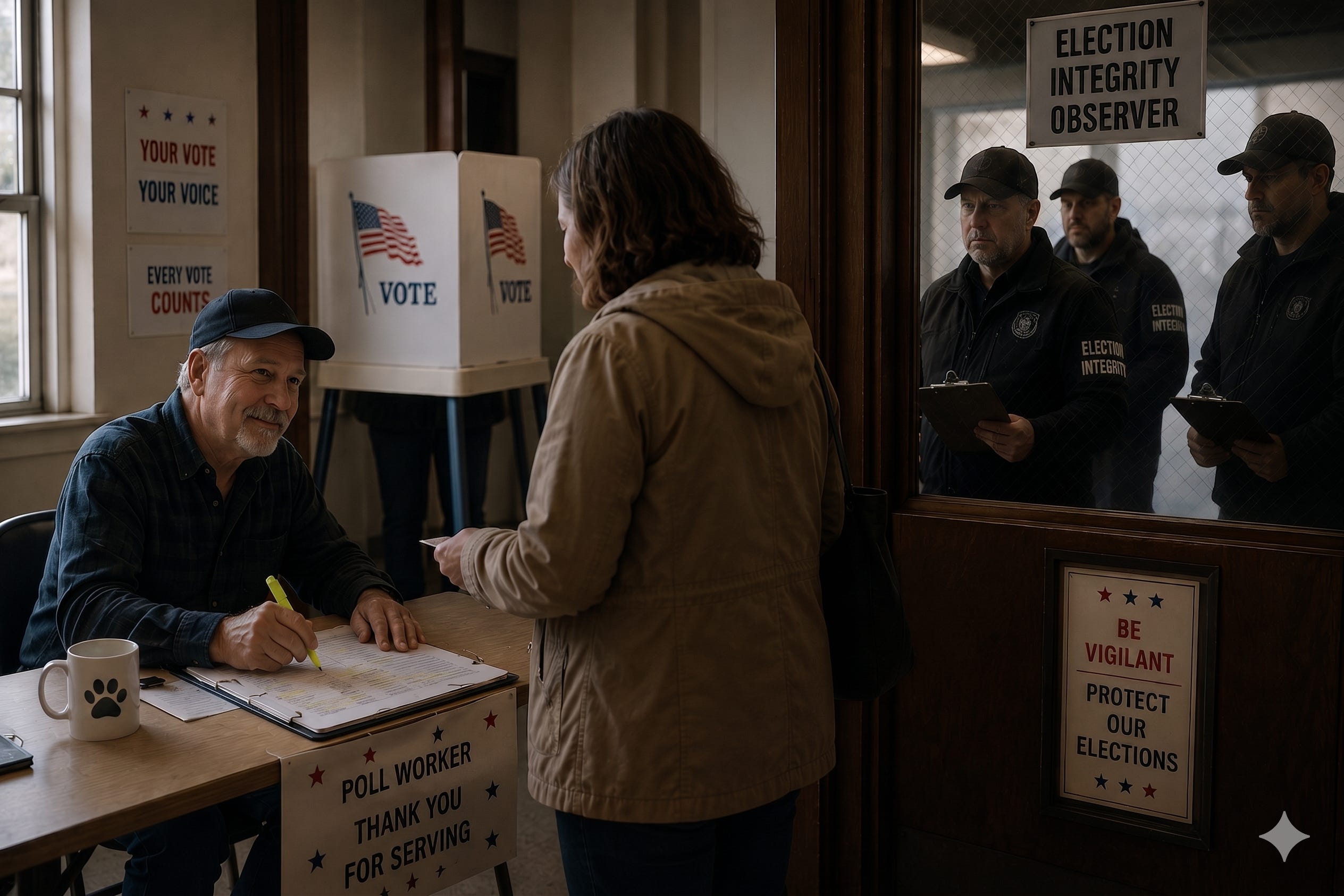
(Image generated using Gemini AI)
The word that matters is not “army.” Everyone has noticed “army,” which arrives with its flags already flying and its intentions declared in advance. The word doing the actual work is the one we read first and pass over too quickly: integrity.
Integrity carries a specific inheritance. It names wholeness, the quality of a thing not divided against itself, the moral condition of the person whose private commitments are indistinguishable from their public ones. When we say a structure has integrity, we mean it holds. To attach that word to a military operation is not a branding accident. It is a semantic instruction: whoever questions the army questions integrity, and whoever stands in its way stands against the uncorrupted thing. Orwell recognized this mechanism. The Ministry of Love administered torture. The Ministry of Peace administered war. The name does not describe the function. The name captures the moral vocabulary, so that opposition is no longer a policy disagreement. It becomes a character verdict. Question the army and you are, by definition, the person without integrity.
There is a 2020 predicate that belongs here. The integrity now being defended was already examined: by courts, by state auditors, by election officials from both parties, by members of Trump’s own administration. The verdict returned from every direction was the same. The election was secure. The army is not being raised in response to a confirmed threat. It is being raised after the threat was confirmed nonexistent. What “Election Integrity Army” announces, then, is not protection. It is the installation of a new authority over what integrity means, and over who gets to say so.
My neighbor works the polling station every election. When I come in to vote, he looks up from the roster and asks about the dogs, or remarks on how tall the kids have gotten. He knows what voting is supposed to feel like: not solemn, not militarized, just a neighbor checking a name against a list.
This is civic life at its most ordinary, and its most essential. The folding table, the paper roster, the highlighter, the curtain. The man behind the table is not a bureaucrat processing units. He is a person who remembers the dogs. The act he performs, running his finger down the list until he finds your name, is an act of recognition: you belong here, this is your precinct, your vote is expected and accounted for. The room does not require an army to feel that way. It requires a neighbor.
What “integrity” was supposed to name, before it was conscripted, was precisely this: the quiet reliability of that room. The assurance that the neighbor with the highlighter will be there, that your name will be on the list, and that the curtain will close behind you. Integrity, in its original application to democratic life, meant the system held. Not the system defended against an imagined enemy. The system that held because it had always held, because it was built from neighbors who showed up with folding tables.
The army does not enter that room to protect it. It enters to change what the room means.
What poll watchers and “election integrity” volunteers actually do is observe and challenge, trained to find irregularities in a system that multiple independent bodies have already confirmed produces very few. The RNC is deploying staff across seventeen battleground states, recruiting volunteers to serve as poll watchers and to assist with election lawsuits. That phrase is worth pausing on: the lawsuits are anticipated before the election occurs, before a single irregular vote has been cast or identified. The army arrives with its legal infrastructure already assembled.
What changes in the room when the army arrives is not the counting. It is the atmosphere. The neighbor with the highlighter is now being watched by people trained to find fault with what he does. The voter arriving at the folding table arrives under observation. The curtain still closes, but the room on the other side of it has changed. This is what military vocabulary does to civilian space: it does not make the space safer. It makes the space feel like a potential battlefield, and once a room is legible as a potential battlefield, the people in it begin to behave accordingly.
Election workers have already faced threats and harassment, not hypothetically but as a documented pattern: actual threats, actual harassment, actual resignations from people who concluded that checking names against a list was no longer worth what it cost them. The “Election Integrity Army” is announced into that climate, with that history already in the room. The neighbor with the highlighter knows this and he shows up anyway. It’s not a small thing, but it’s also not a situation the army was designed to improve.
My neighbor does not think of himself as guarding democracy. He thinks of himself as showing up. He has the roster, the highlighter, the folding table, and enough memory to ask about the dogs. That is what he brings to the room, and it turns out that is exactly what a functioning election requires.
The army has no use for any of that. It does not need neighbors who remember the dogs. It needs observers, challengers, a legal infrastructure assembled in advance of the irregularities it is there to find. It needs the word “integrity” to mean what it has decided integrity means: not the system that held, but the system that holds only so long as the right people are watching.
This is the breakdown the title promises and delivers. “Election Integrity Army” is not a contradiction in terms. It is a precise description of what happens when a word is fully captured: the thing the word used to name becomes invisible, and the army that replaced it becomes the only proof the word still has any content at all.
My neighbor will be there in November. He will ask about the dogs.